
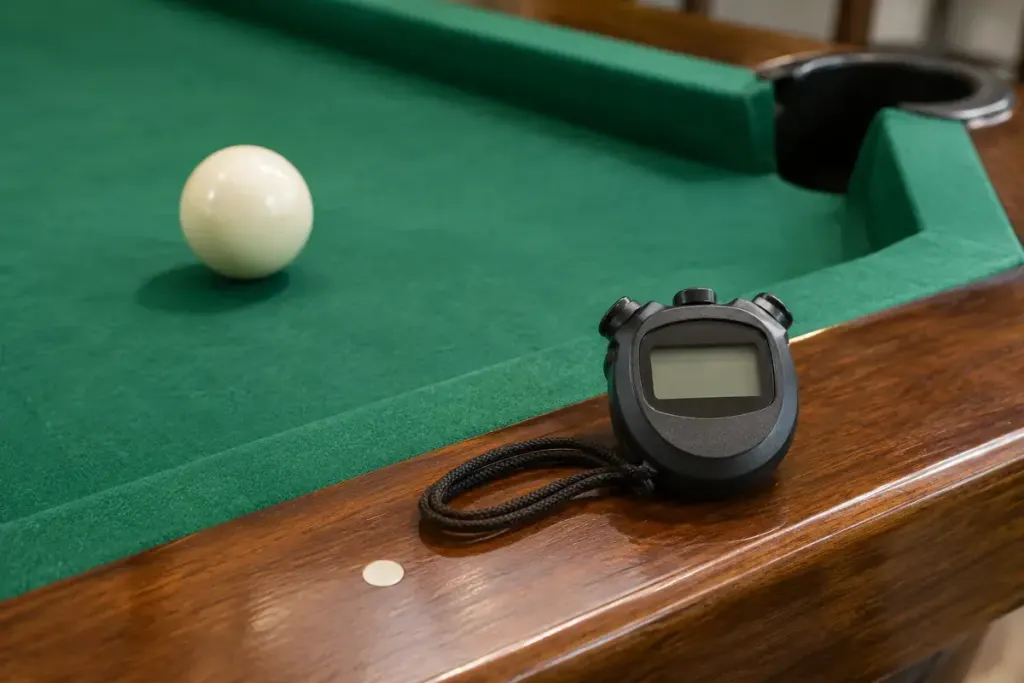
The countdown reaches zero while a player is still settling over the cue ball. Whether the shot can proceed is not a matter of table manners: a timed match needs a stated procedure and someone responsible for applying it.
The WPA playing regulations dated 15 September 2025 describe a recommended shot-clock arrangement, including a warning, an extension and the point at which timing begins. Tournament conditions can specify their own application, so check the rules adopted for the event rather than assuming every broadcast uses the same clock.
Find the start and finish of the timed interval
Under that WPA guidance, the clock starts when the balls have stopped, including any that are still spinning. It ends when the cue tip strikes the cue ball to begin the stroke or when the allowed time expires. Getting into a stance is therefore not the same as completing the timed requirement.
Before the match, ask how warnings are given, how an extension is requested and how many are available. Also clarify the procedure when a referee must inspect a position or deal with an equipment issue. Do not assume that speaking to the opponent automatically pauses the clock.
Practise the routine, not a rushed final stroke
In practice, use a timer to notice where your decision time goes. Separate reading the layout, selecting the shot and approaching the cue ball. The purpose is to make a dependable routine, not to train yourself to hit before you are safely and properly set.
For a friendly timed session, agree the rule in writing before starting and apply it to both players. If you are preparing for competition, use that competition’s actual timing conditions.
When watching a match, follow the official warning and extension indication rather than estimating time from an edited clip. The visible countdown is only the display; the event’s procedure explains what it means.