
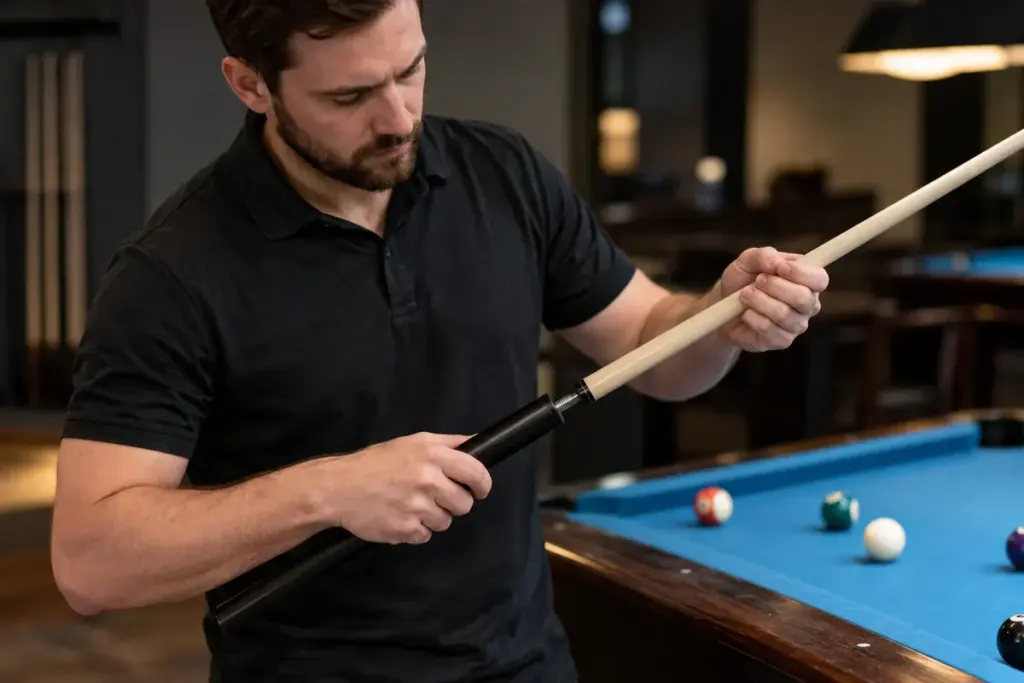
A cue extension solves a reach problem by changing the equipment in your hands. That extra length can also change how the cue feels during the stroke. Trying it for the first time over an awkward match shot leaves little room to learn either difference.
Check that the extension is designed for the cue and attach it according to the maker’s instructions. A loose joint or incompatible fitting is not something to compensate for with a firmer grip. Inspect the connection before taking practice strokes.
Begin with a simple straight shot that requires only modest extra reach. Set up a comfortable bridge and check that the cue can move freely through the full intended stroke. Do not stretch farther merely because the cue is longer; the stance and bridge still need to be stable.
Notice where your grip hand naturally settles. Compare a few gentle strokes with your normal setup, paying attention to balance and clearance rather than immediately judging potting success. A missed ball can have several causes, so change one feature at a time.
Practise the decision as well as the shot
Set up three positions: one you can reach normally, one where an extension helps and one where a mechanical bridge is the more comfortable option. Rehearse choosing the aid before you settle into the stance. This avoids a sequence of stretching, standing up and changing equipment under time pressure.
- Check the competition’s equipment rules.
- Keep the extension easy to retrieve without disturbing other players.
- Practise removing it securely after the shot.
- Stop if the fitting moves or the cue behaves unexpectedly.
A useful practice result is a repeatable setup and a clearer boundary for when to use the extension. Extra reach is valuable when it supports a controlled stroke, not when it encourages a position you cannot comfortably maintain.