
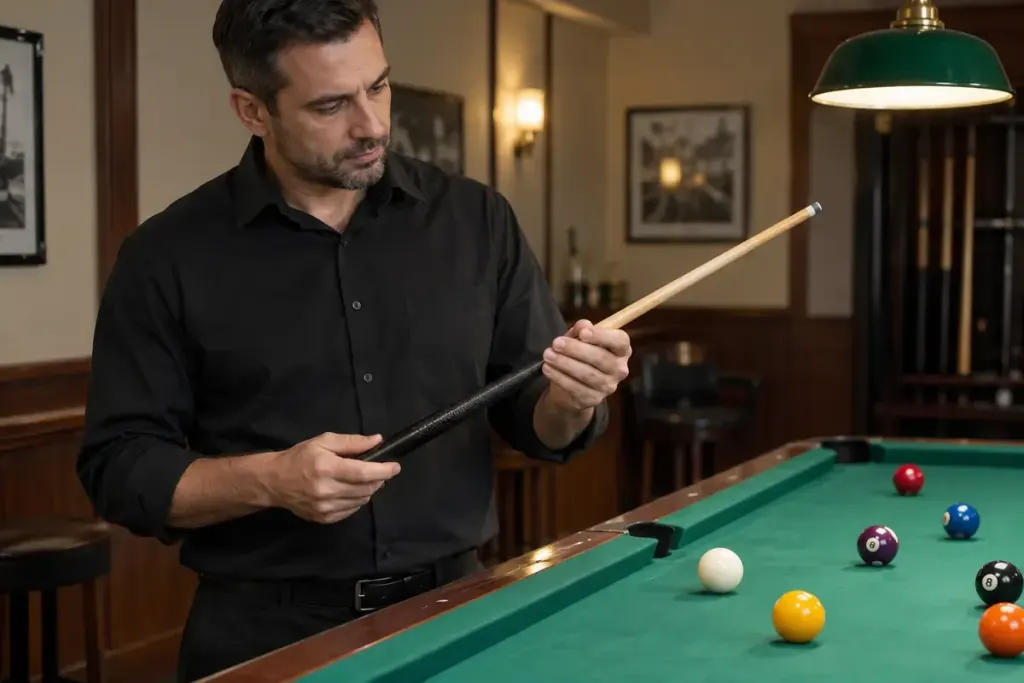
Seeing the cue ball rise over another ball does not, by itself, tell you whether the stroke was legal. The way it left the cloth matters. A controlled jump and a scoop from underneath can produce superficially similar airborne results through different contact.
The WPA Rules of Play, sections 2.9 and 2.11, describe a legal jump as a stroke with an elevated cue that drives the cue ball into the playing surface so it rebounds. The rules treat a scoop, where the tip contacts the cloth and ball together, as a miscue. They also distinguish an unintentional miscue from an intentional one; the latter falls under unsportsmanlike conduct.
Do not reduce the rule to “any airborne ball is a foul”
That shortcut misses the distinction between a legal jump, an accidental miscue and a deliberate attempt to scoop. It can also lead players to argue from the final path rather than the stroke. Use the rules for the discipline and event being played, including any equipment restrictions.
A pool room may prohibit jump practice to protect its tables even when a competition ruleset permits jump shots. Ask before practising. A player’s familiarity with a rule does not override the venue’s conditions for using its cloth and equipment.
Learn the contact under supervision
A qualified instructor can demonstrate the stroke and explain how a suitable cue is used without encouraging repeated uncontrolled impacts. Do not try to reproduce a dramatic video by digging the tip beneath the ball. Start with the room’s permission, an appropriate setup and an explanation of what the tip is supposed to do.
When watching a match, note whether the cue was elevated and whether there was an obvious miscue, but leave close officiating decisions to the referee with the relevant view. Slow motion can help explain an action, yet a camera angle can still hide the contact.
The aim is not simply to make the ball fly. It is to play an allowed stroke, control the next position and leave the table in the condition in which you found it.