
The first disagreement in a friendly game often starts with “That’s how we always play.” Both players may be sincere. They may also be remembering different disciplines, league rules or local customs.
A brief conversation before the break is easier than an argument after a decisive shot. You do not need to recite a rulebook. You do need to establish which game you are playing and where you will look when a question arises.
Name the game and the rules source
Say whether you mean eight-ball, nine-ball or another discipline. Then identify the rules you intend to use. The World Pool-Billiards Association’s rules page provides official documents for its disciplines. A local league or venue may use a different set; agree on the applicable version rather than blending remembered rules from several sources.
If you are adopting a house variation for a casual game, make it explicit. A shared variation can work between consenting players, but it should not be presented as the universal rule or carried into an event that specifies something else.
Choose the questions most likely to interrupt play
Ask how the break is handled, what must be called, what happens after a foul and how a win or loss is determined under the chosen rules. These topics are easy to confuse when people switch between games. Look up the relevant section together before a disputed situation occurs.
Avoid using an informal phrase as a complete explanation. If somebody says “ball in hand,” clarify what the agreed rules permit in that situation. The point is not to invent a compromise after the shot; it is to know the governing procedure in advance.
Settle the practical arrangements too
Decide who breaks first, how you will keep score and whether you are playing one rack or a longer match. At a shared venue, check time limits and table charges with the staff. Put drinks and other belongings where the venue allows, away from the playing surface.
If either player expects coaching or a practice restart, say so before the session. A relaxed teaching game and a scored match ask for different behaviour. Neither player should discover halfway through that they agreed to a different kind of evening.
Have a calm procedure for an unclear incident
When uncertainty arises, pause before the next shot and consult the selected rules or a referee where one is available. Describe what happened without turning the discussion into a judgment about the other player’s honesty. If no one saw enough to resolve it, follow the procedure applicable to your game or event.
In a casual practice session, you can also decide to stop scoring that rack and use the position as a learning example, provided both players agree. That is a social choice for your session, not a replacement for competition rules.
Keep a short agreement you can remember
A useful opening conversation might be: “Eight-ball, this rules document, race to three, alternating breaks as our agreed match format, and we pause to look up anything unclear.” Adjust the format to the rules and setting you actually use.
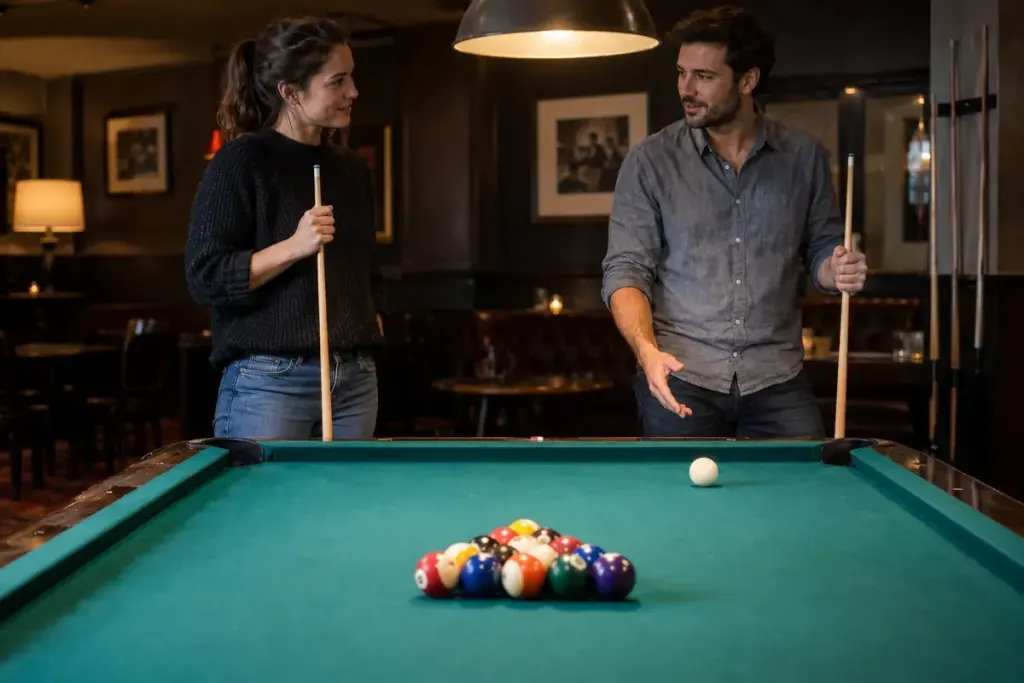
The payoff is not just fewer disputes. Clear expectations let both players concentrate on the table. The accompanying generated photograph is atmospheric illustration, not a diagram of a regulation rack or an example to copy for ball placement.