
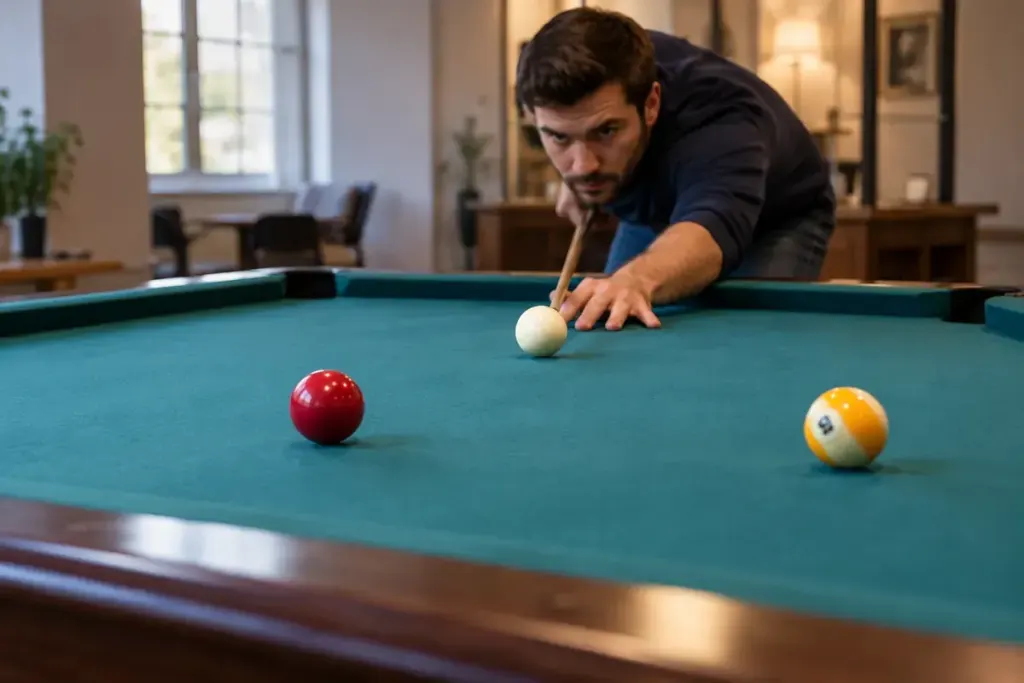
A striped ball drops into the called pocket after a neat combination. If you are playing stripes, that looks promising. The ruling still depends on what the cue ball contacted first.
Under the World Pool-Billiard Association’s rules, once groups are assigned and you still have balls in your group, the cue ball’s first object-ball contact must be with your group. Calling the eventual pocket does not waive that requirement. Check the rules adopted by your event, since local eight-ball variants can differ.
Trace an invented shot in order
Suppose you have stripes. The cue ball hits a solid, which then knocks your called stripe into its called pocket. The successful pot does not repair the wrong first contact: under the stated rules, the shot is a foul.
Now change the arrangement. The cue ball first contacts a stripe, which starts a sequence that pockets the called stripe in the called pocket. The initial group requirement is satisfied, although the shot still has to meet the other rules. A legal first contact is one condition, not a blanket approval of everything that follows.
Before playing, identify the first intended contact, the called object ball and the pocket. They are three different pieces of information. On a crowded table, an opponent may see the final pot clearly while missing the first collision.
Do not carry the example into every table state
An open table has its own group-selection provisions. Once your group is cleared and you are playing the eight, the eight-ball requirements apply. The example above deliberately assumes assigned groups with your group still on the table.
If a close contact could be disputed, ask for a referee or agreed observer before the shot. Do not reconstruct certainty from the sound after the balls have moved.
For practice, set up a slow, simple combination and name the first contact aloud before shooting. Learning to see the chain in order helps both tactical planning and a calmer rules discussion when a good-looking pot is not a legal one.