
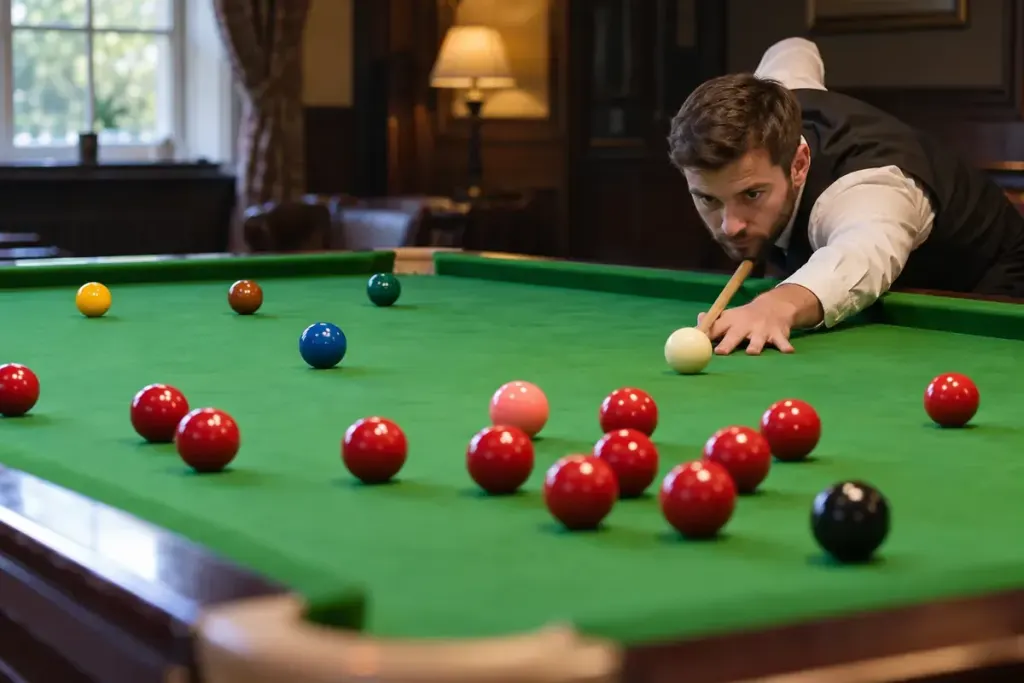
The referee calls a foul, then announces a free ball. A beginner may assume the incoming player can now pot any ball for its normal value. The important idea is more precise: a nominated ball can stand in for the ball that should otherwise be played.
The WPBSA rules of snooker set out the free-ball procedure when the player is snookered after a foul. The referee’s decision, the ball on, and the nomination all matter. A difficult shot alone does not create a free ball.
Start by identifying the ball on
During the red-ball phase, a red may be the ball on. If a free ball is awarded, another ball can be nominated to play as that red. Its role changes for this stroke; its usual colour value is not automatically added to the score.
For a simple example, suppose red is on and the player nominates blue as the free ball. Potting that nominated blue scores the value of a red, and the blue is respotted. The player can then continue according to the normal sequence after potting a red. This example is about the nominated ball alone, not every possible combination of balls potted in one stroke.
Separate the foul from the scoring opportunity
The foul has its own penalty. The free ball is a consequence of the position left after the foul, not an extra colour-sized bonus added to that penalty. This distinction makes a televised scoreboard easier to follow: first account for the foul points, then follow any points scored during the incoming player’s visit.
At a club table, pause long enough to agree on the referee’s decision and the nomination before the shot. If there is no referee, consult the rulebook rather than relying on a remembered television situation with different balls remaining.
When watching a match, try recording three things on paper: the ball on before the stroke, the ball nominated, and the value awarded if it is potted. That small exercise is more revealing than memorising a list of colour values. Later, the rulebook’s less common cases will make more sense because the basic substitution is clear.