
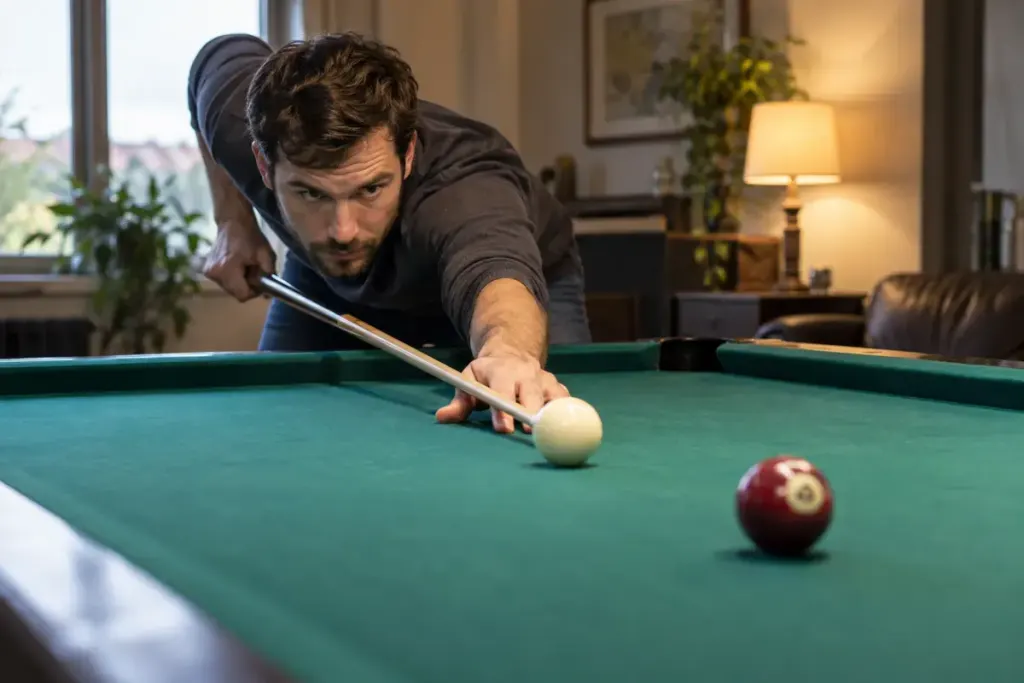
Potting the object ball answers only half the question. Where did the cue ball finish? On a straightforward follow shot, forward rotation helps the cue ball continue ahead after contact instead of stopping at the collision point.
Dr Dave’s follow-shot resources explain the mechanics in greater depth. For an initial practice, the useful task is observation: make a simple layout repeatable enough to see what changes.
Choose a modest straight shot
Set up a comfortable straight-in pot with room beyond the object ball. Use a legal, controlled stroke and a sensible contact point above the cue ball’s centre, staying within your ability to avoid a miscue. Do not begin with an extreme tip position or a powerful stroke.
Keep the ball positions and intended stroke speed similar across a short set. After each attempt, note whether the cue ball followed, how far it travelled and whether you actually delivered the straight pot. A missed pot changes the collision, making distance comparisons less useful.
Change one part of the task
Once the layout feels repeatable, choose a nearby resting area for the cue ball. Try to reach that area with controlled speed rather than simply producing more forward travel. Record the result in ordinary terms: short of the area, within it or beyond it.
A rolling cue ball can already carry forward rotation before impact, so the outcome is not determined by tip height alone. Distance to the object ball, speed and table conditions matter. Avoid treating one successful shot as a universal setting that will work from every position.
If the cue rises, your bridge shifts or contact becomes inconsistent, simplify the exercise. An instructor can help distinguish a delivery problem from an aiming or speed-control problem.
Finish by playing the same pot with a position target for the next shot. Follow becomes useful when it leaves a manageable continuation, not merely when the cue ball travels impressively far.