
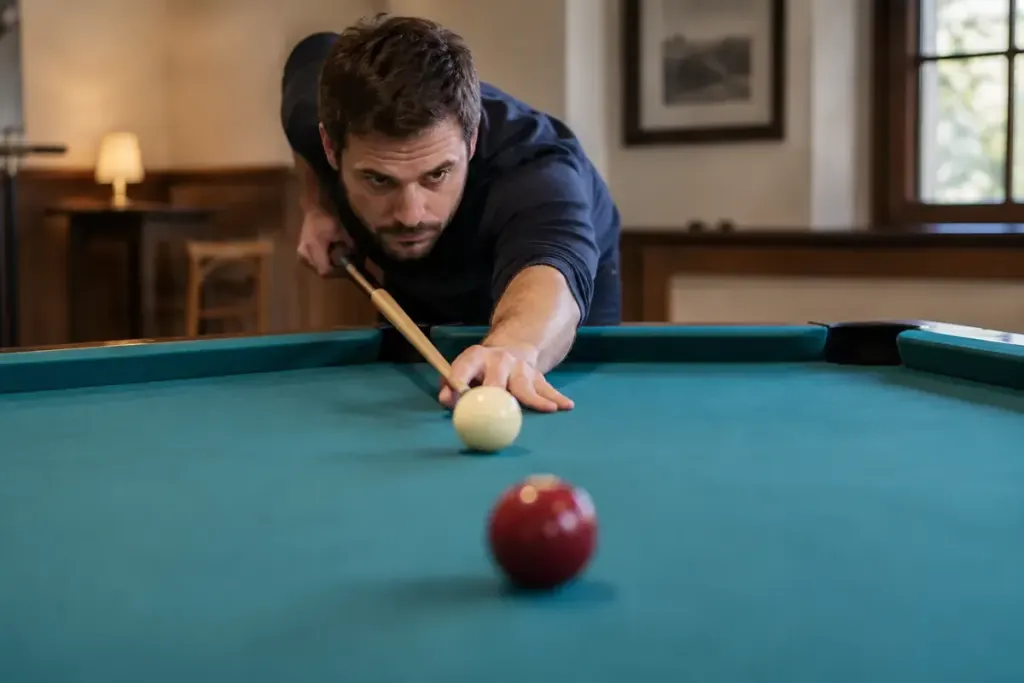
A difficult pot gives you many possible explanations for a miss: aim, speed, spin, position or cue delivery. A simpler exercise can remove some of that noise. The purpose is not to prove that your stroke is perfect; it is to make one feature easier to observe.
Start with a repeatable line
On an unobstructed table, choose a short, comfortable straight shot and mark the ball positions using a method permitted by the venue. Use ordinary centre-ball contact and a gentle, controlled pace. Avoid adding side spin or increasing the distance until you can repeat the setup reliably.
Take your normal stance without forcing it into a photograph of someone else’s. Make a few relaxed practice movements and notice whether the cue follows the intended line. If the position causes pain or strain, stop and ask a qualified coach to help you adjust it.
- Set the same two ball positions.
- Choose the same intended pace.
- Play a small group of shots, pausing between them.
- Record the direction of misses rather than only the number potted.
A cluster of misses on one side is information, not a diagnosis. It may involve alignment, unwanted spin or another part of the movement. Ask a coach to observe from an appropriate angle instead of changing several parts of your stance at once.
Use video as a question, not a verdict
With the venue’s permission and without filming other players, a stationary phone can help you compare attempts. Position it safely away from play. Watch whether the movement changes between a relaxed practice stroke and the actual delivery.
Choose one adjustment suggested by observation or coaching, then repeat the same exercise. A new distance, new speed and new grip together make the comparison difficult. End while you can still concentrate. Five attentive repetitions can teach you more about the chosen question than a long session of hurried shots that gradually become a different drill.