
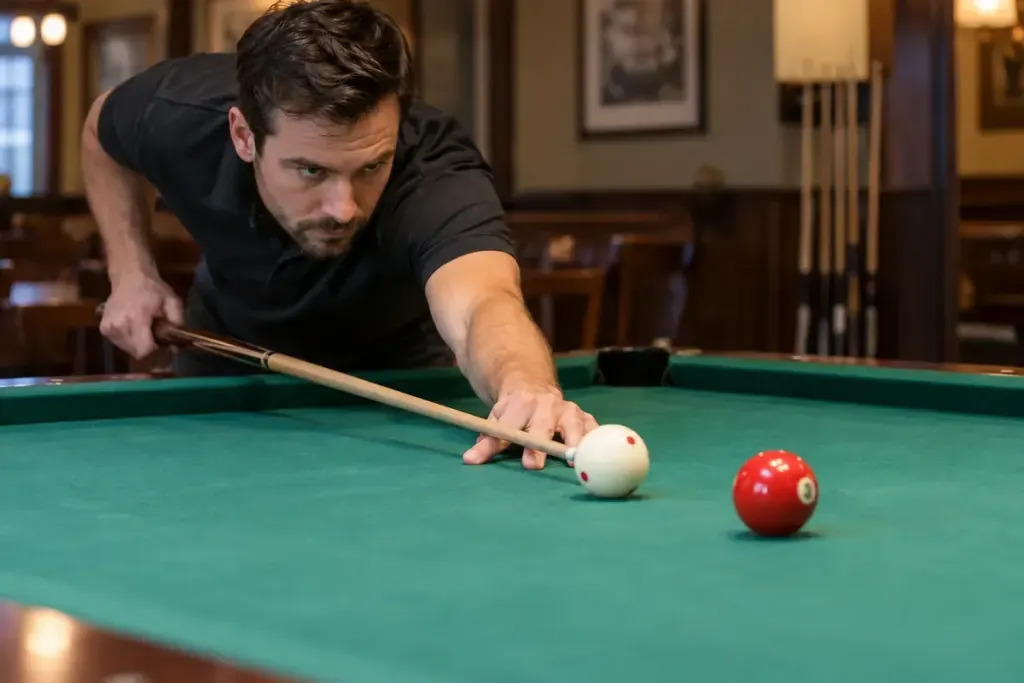
You can see where the object ball needs to go, but not quite where the cue ball must arrive. The ghost-ball idea gives that missing position a shape: imagine a cue ball touching the object ball on the line opposite the intended pocket.
Build the picture with an easy layout
Choose a modest cut shot with clear space, well away from cushions and other balls. Extend an imaginary line from the pocket through the object ball. The imagined cue ball sits on the continuation of that line, touching the object ball. Its centre becomes a useful starting point for visualising the cue ball’s approach.
During practice, an instructor can help demonstrate the position with a spare ball before removing it. Follow the venue’s rules about practice aids and marking the cloth. Do not leave an extra ball in the path while taking the shot.
Keep the picture separate from the stroke
Use a comfortable stance and a controlled stroke. Watch whether the cue ball reaches the intended area. If the shot misses, record the direction and repeat the same layout rather than immediately changing the angle, speed and spin together.
The imagined position is a teaching model, not a promise of perfect accuracy. Collision effects, spin, speed and the condition of the balls can alter a real shot. At sharper angles, a simple visual picture can become harder to judge. An instructor can help distinguish an aiming issue from an inconsistent delivery.
Try three repeats, then step away and set up again. Can you rebuild the picture without relying on the position of your feet from the previous attempt? That is a more useful test than making one pot after several tiny unrecorded adjustments.
Keep the next cue-ball position in mind once the basic pot becomes comfortable. Aiming the first collision is only part of playing the whole shot.
The ghost ball earns its place when it turns a vague feeling into something you can describe and test. Use it to ask a clearer question about contact, while leaving room for what the actual balls show you.