
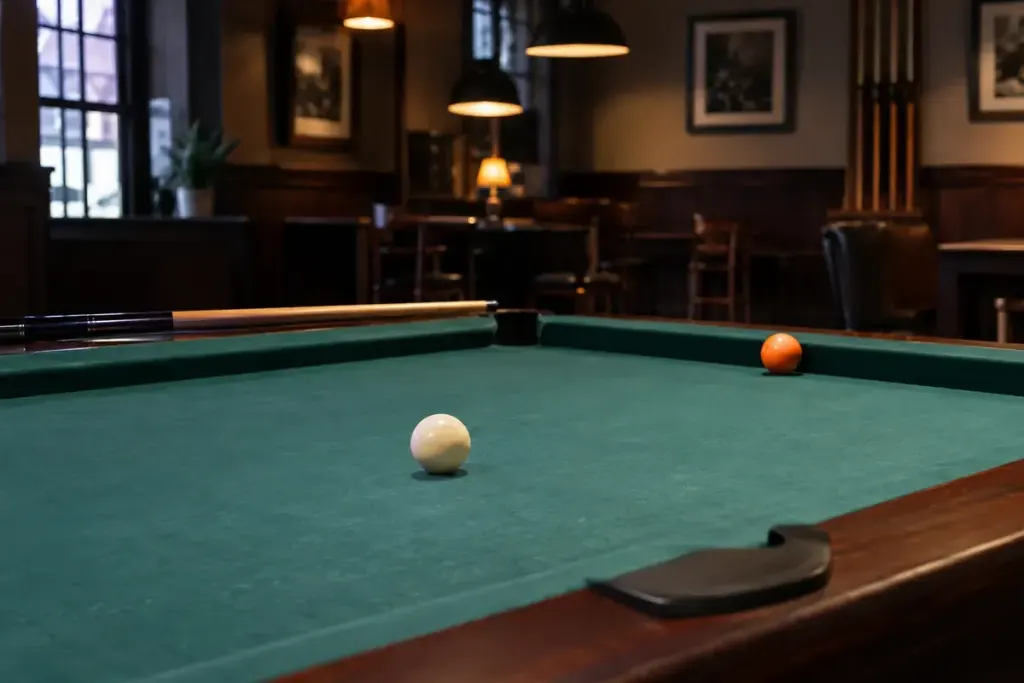
The imagined mirror line looks perfect, yet the object ball misses after touching the cushion. A bank shot is not a geometry diagram with friction removed. Speed, spin, contact and table conditions can all change the result.
Keep the first experiment small
Choose a straightforward object-ball bank on a table where practice is permitted. Record the starting positions using the table diamonds as references; do not mark or stick anything to the cloth without permission. Use a repeatable centre-ball stroke and keep the intended contact point unchanged.
Play a few attempts at one comfortable speed, then a few slightly firmer. Watch where the object ball returns relative to the intended pocket. Do not change aim after every miss, or you will lose track of whether speed or alignment produced the difference.
Make a simple record: starting position, intended aim, speed category and which side of the pocket the ball passed. The labels “gentle” and “firm” are only personal references; they are not measured velocities or a formula that transfers exactly to another table.
Separate a pattern from a poor sample
If attempts at the same speed scatter widely, work on repeatability before drawing conclusions about the cushion. Accidental side spin, inconsistent contact and a changing stance can hide the effect you meant to examine.
Once a pattern is repeatable, alter one feature—perhaps the starting distance—and repeat the observation. Save complicated combinations of cut angle and deliberate side spin for later. A clean experiment should answer one question, not produce an impressive-looking shot.
The reward is a better adjustment process during a match. Instead of treating every missed bank as mysterious, you can ask whether the stroke, speed or assumed rebound path differed from the one you practised.